
Ginger
GRASZingiber officinale

Botanical illustration — Zingiber officinale
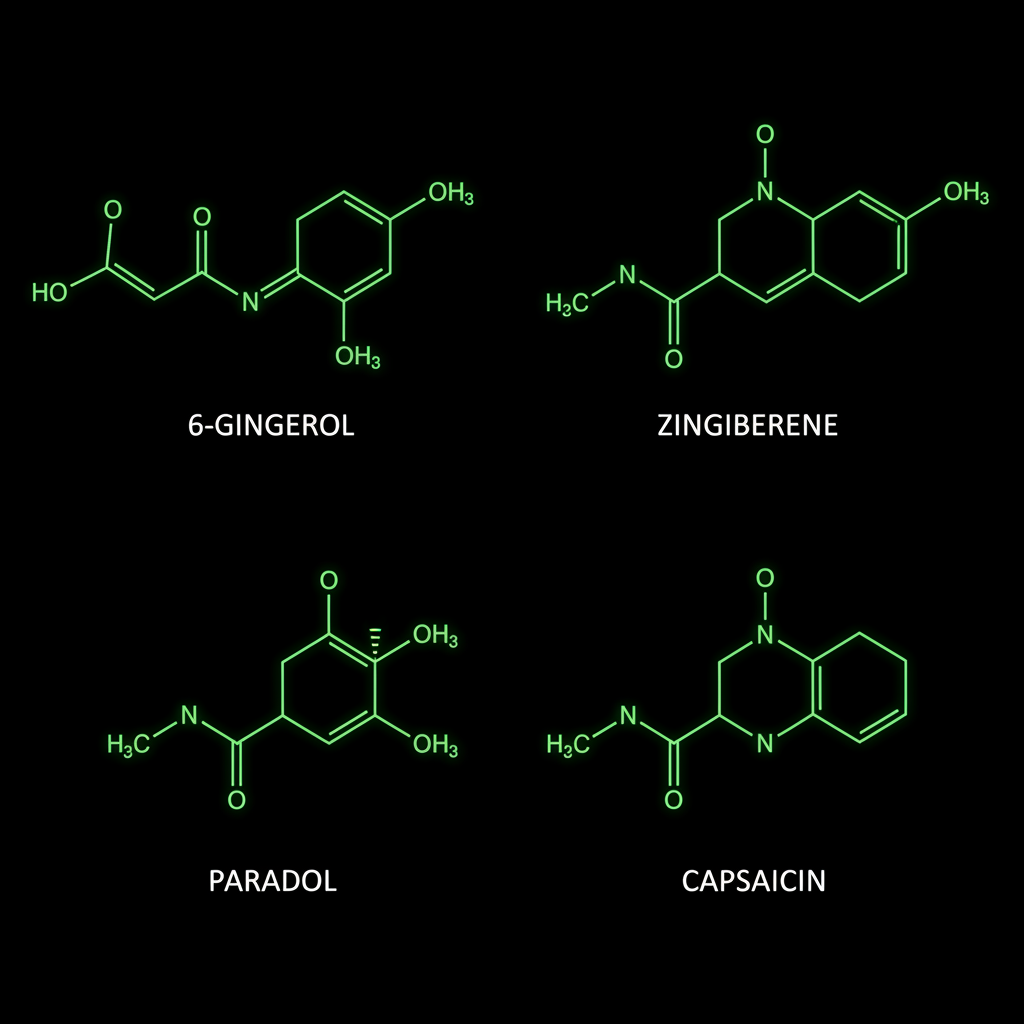
Molecular structures — key phytochemicals
Botanical Profile
A flowering plant whose rhizome is one of the most widely used spices and medicinal herbs globally. Documented use spans ancient Sanskrit, Chinese, Greek, Roman, and Arabic medical texts. Modern research validates its antiemetic, anti-inflammatory, and digestive properties.
Morphology
Herbaceous perennial reaching 90–120 cm in height. Pseudostem formed by rolled leaf sheaths. Lanceolate leaves 15–30 cm long. Rhizomes are knobby, branched, pale yellow internally with a characteristic pungent aroma. Flower spikes are cone-shaped with pale yellow and purple-tinged bracts.
Traditional & Ethnobotanical Uses
In Traditional Chinese Medicine, ginger is used to warm the spleen and stomach, dispel cold, and as an antiemetic. Ayurvedic texts describe it as a universal medicine (vishwabhesaja) for digestive disorders, nausea, arthritis, and respiratory conditions. Greek physicians Dioscorides and Galen documented its use for digestive complaints. Traditional applications include colds, cough, arthritis, motion sickness, and morning sickness.
Phytochemical Profile
The pungent principles are gingerols and shogaols (1–3% of fresh rhizome), with [6]-gingerol being the most abundant. Gingerols can dehydrate to form the more pungent shogaols during drying. Also present are paradols, zingerone, and gingerdiones. The essential oil (1–3%) contains sesquiterpene hydrocarbons including zingiberene (20–30%), β-sesquiphellandrene, and β-bisabolene. Ginger also contains diarylheptanoids with antioxidant activity. Fresh and dried forms have distinct phytochemical profiles.
Mechanisms of Action
Antiemetic activity via 5-HT3 receptor antagonism in the GI tract and central serotonin pathways. Anti-inflammatory effects through COX-1 and COX-2 inhibition, 5-LOX inhibition, and suppression of TNF-α and IL-1β. [6]-Gingerol and [6]-shogaol modulate NF-κB and MAPK signalling pathways. Gastroprotective effects include stimulation of gastric mucus secretion and modulation of gastric motility. Thermogenic activity through enhancement of catecholamine release. Analgesic effects via modulation of vanilloid receptors.
Clinical Indications
Conditions
Symptoms
Dosage & Preparation
For nausea: 1–1.5 g dried root daily in divided doses, or 1–2 g fresh rhizome. For osteoarthritis: 250 mg of standardised extract (5% gingerols) 2–4 times daily. Standardised extracts providing 5% gingerols: 100–200 mg three times daily. For motion sickness: 1 g 30 minutes before travel. Maximum recommended daily intake: 4 g dried root equivalent.
Safety & Interactions
Contraindications
Caution in gallstone disease (stimulates bile secretion). Contraindicated before surgery due to antiplatelet effects. Caution in individuals with GERD or gastric ulcers at high doses. Large doses may cause heartburn or GI irritation. Pregnancy: generally considered safe at dietary doses; therapeutic doses should be supervised.
Drug Interactions
Anticoagulants and antiplatelet agents (warfarin, aspirin) — theoretical additive bleeding risk. Phenprocoumon — potential increased INR. Antidiabetic medications — may enhance insulin sensitivity, requiring glucose monitoring. Cardiovascular medications — may have additive hypotensive or antiarrhythmic effects.
My Research Notes
No notes yet.
References
- [1]Viljoen E, et al.
- [2]A systematic review and meta-analysis of the effect and safety of ginger products in the treatment of chemotherapy-induced nausea and vomiting.
- [3]Nutr Rev. 2014.
- [4]43(4):245-54.
- [5]Bartels EM, et al.
- [6]The efficacy of ginger for treating osteoarthritis: a systematic review and meta-analysis.
- [7]Arthritis Care Res. 2015.
- [8]67(5):634-42.
- [9]Bode AM, Dong Z.
- [10]The amazing and mighty ginger.
- [11]In: Herbal Medicine: Biomolecular and Clinical Aspects. 2nd ed.