
Cannabis Indica
ConditionalCannabis indica
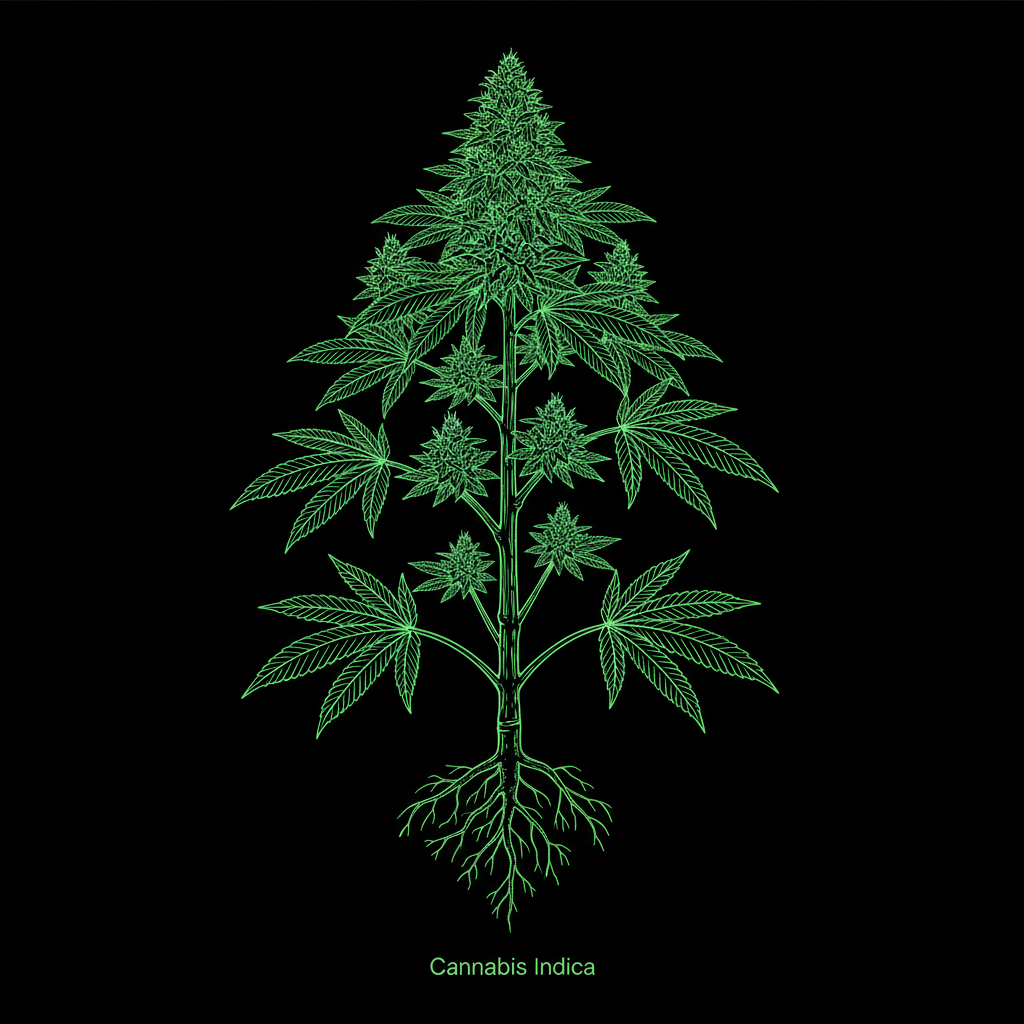
Botanical illustration — Cannabis indica
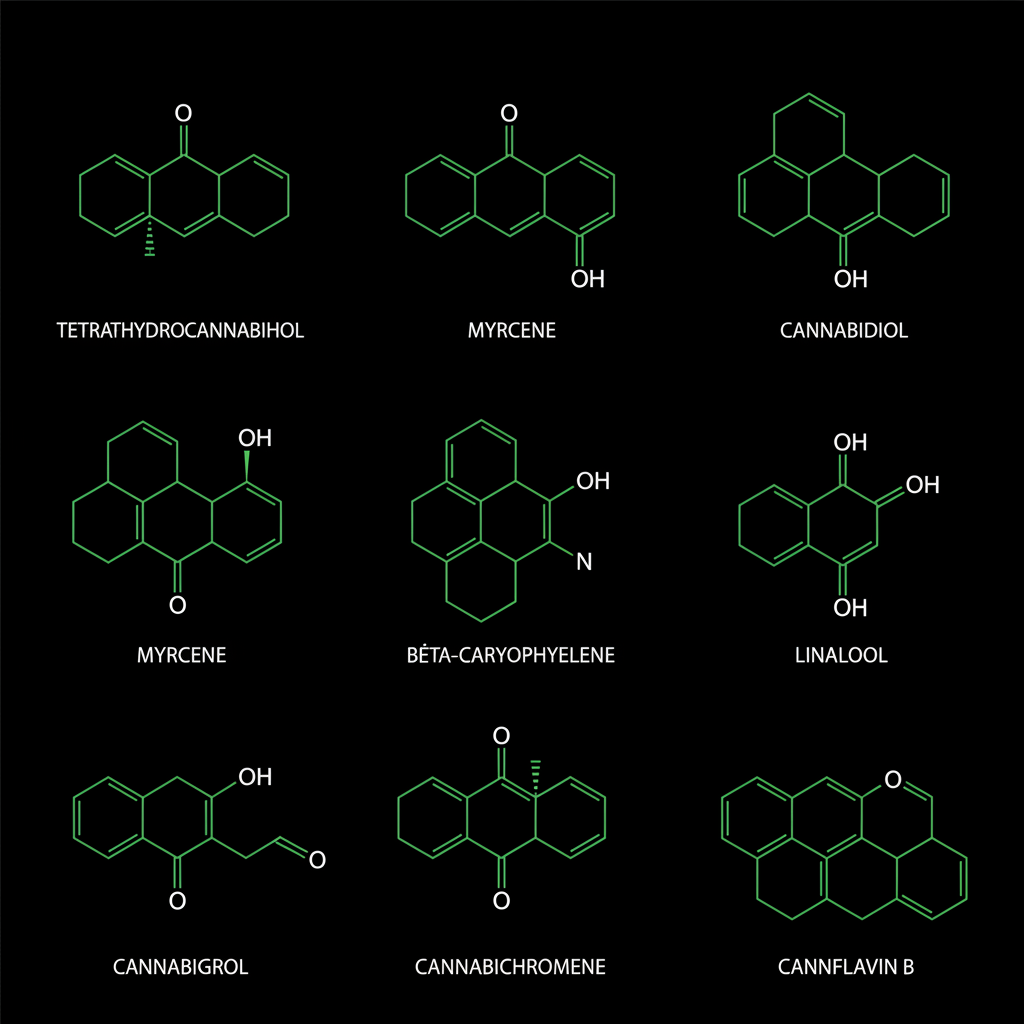
Molecular structures — key phytochemicals
Botanical Profile
Cannabis indica is a shorter, bushier, densely branched species or subspecies within the Cannabis genus, native to the Hindu Kush mountain range and surrounding regions of Afghanistan, Pakistan, and India. Indica-dominant varieties are traditionally associated with relaxing, sedating, body-centred ('couch-lock') effects and tend to be higher in CBD relative to sativa varieties, though modern drug-type indicas still produce substantial THC. They are favoured for evening use, sleep, pain relief, and muscle relaxation.
Morphology
Cannabis indica plants are typically short to medium in height (0.6–2 m), with broad, dark-green leaflets (often 5–7 per leaf). The internodal spacing is tight, producing a bushy, conical canopy. Flowers are dense and highly resinous, adapted to harsh mountain climates. Trichome density is typically very high, with large glandular heads rich in cannabinoids and aromatic terpenes.
Traditional & Ethnobotanical Uses
In the Indian subcontinent, Cannabis indica was historically used in the preparation of charas (hand-rubbed hashish), bhang, and ganja. It was used in Ayurvedic and Unani medicine for insomnia, pain, anxiety, digestive disorders, and as an aphrodisiac. Sufi mystics in the region used hashish for meditation and spiritual contemplation. In Afghanistan, the resin has been collected for centuries for both medicinal and recreational use.
Phytochemical Profile
Indica-dominant varieties typically present moderate to high THC content (12–20%) with relatively higher CBD levels compared to sativa-dominant varieties. Key terpenes include myrcene (earthy, sedative), linalool (floral, anxiolytic), and caryophyllene (peppery, anti-inflammatory). The high myrcene content (>0.5%) is theorised to contribute to the characteristic sedative 'couch-lock' effect. Other compounds include CBG, CBC, CBN, and various flavonoids.
Mechanisms of Action
Cannabinoids act on CB1 and CB2 receptors of the endocannabinoid system. The sedative and muscle-relaxant properties of indica varieties are attributed to the combined effects of THC on CB1 receptors and the presence of myrcene, which has demonstrated sedative and muscle-relaxant properties in animal studies. Linalool contributes anxiolytic effects via modulation of glutamate and GABA neurotransmission. Beta-caryophyllene acts as a CB2 agonist with anti-inflammatory properties.
Clinical Indications
Conditions
Symptoms
Dosage & Preparation
Inhaled THC: 1–5 mg per session for sedative/analgesic effects. Oral THC: 2.5–10 mg, typically taken 1–2 hours before sleep. CBD: 25–150 mg/day for sleep and anxiety support. Titrate slowly, especially with edibles due to delayed onset (1–3 hours).
Safety & Interactions
Contraindications
Avoid in individuals with psychotic disorders. Caution in pregnancy and breastfeeding. Heavy machinery and driving should be avoided due to sedation. Adolescents should avoid THC-containing products.
Drug Interactions
Metabolised by CYP2C9 and CYP3A4. Additive sedation with benzodiazepines, opioids, and alcohol. CBD may alter plasma levels of clobazam, warfarin, and other CYP-metabolised drugs.
My Research Notes
No notes yet.
References
- [1]Hillig KW, Mahlberg PG. (2004).
- [2]A chemotaxonomic analysis of cannabinoid variation in Cannabis.
- [3]Am J Bot. 91(6):966-75. 2.
- [4]Russo EB. (2011).
- [5]Taming THC: potential cannabis synergy and phytocannabinoid-terpenoid entourage effects.
- [6]Br J Pharmacol. 163(7):1344-64. 3.
- [7]Clarke RC, Merlin MD. (2013).
- [8]Cannabis: Evolution and Ethnobotany.
- [9]University of California Press..
Latest Research
PubMed LiveNo recent publications found.