
Valerian
ConditionalValeriana officinalis
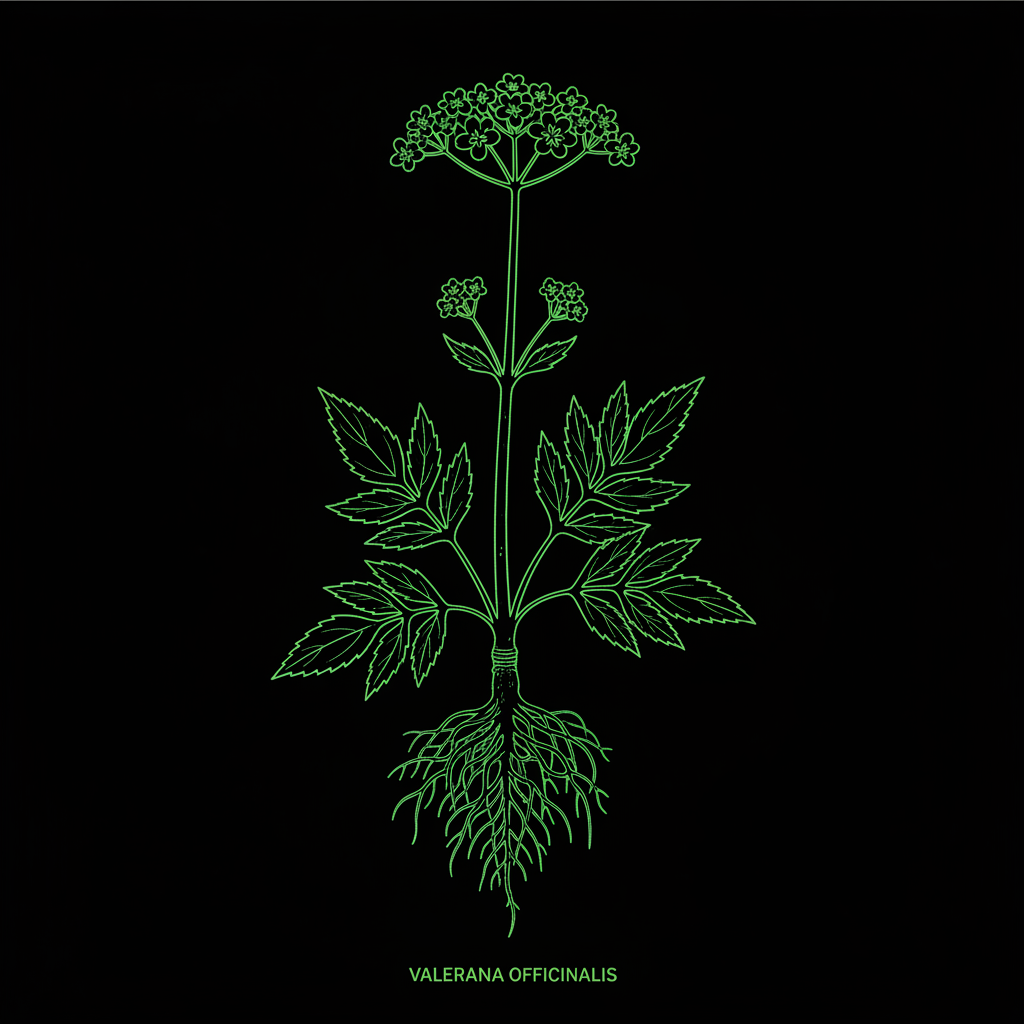
Botanical illustration — Valeriana officinalis
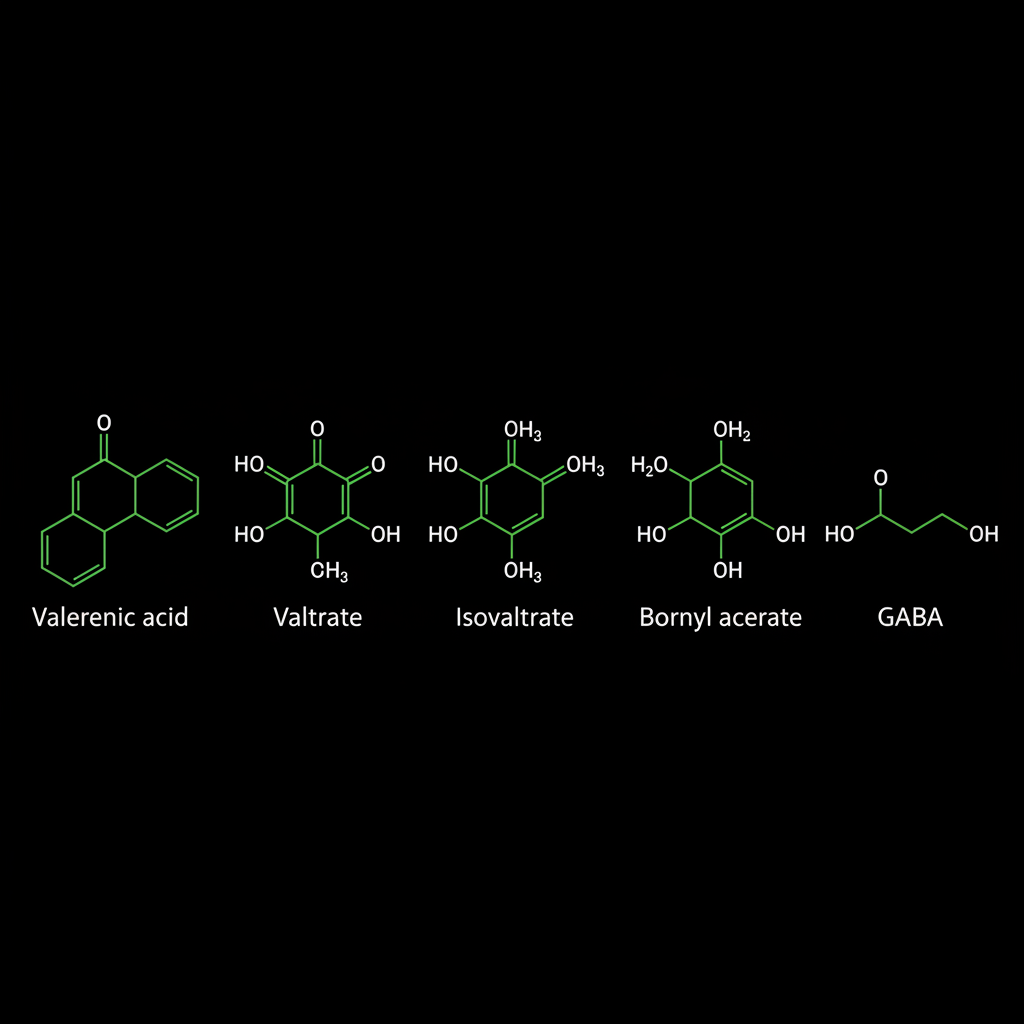
Molecular structures — key phytochemicals
Botanical Profile
A perennial flowering plant whose root has been used as a sedative and anxiolytic since ancient Greece and Rome. Valerian remains one of the most clinically studied herbal sedatives, with substantial evidence supporting its use for insomnia and anxiety.
Morphology
Herbaceous perennial growing 50–100 cm in the first year, up to 150 cm when flowering. Pinnately divided leaves with 6–10 pairs of lanceolate leaflets. Small white to pale pink flowers in dense cymose inflorescences with a sweet, honey-like fragrance. Roots are short, thick, and yellowish-grey with a distinctive strong, musky odour when dried.
Traditional & Ethnobotanical Uses
Described by Hippocrates and Galen for insomnia, anxiety, and digestive disorders. In medieval Europe, used as a remedy for epilepsy, nervous unrest, and as a general calmative. Native American tribes used related species (V. wallichii) for wound healing and digestive issues. Traditional use for menstrual cramps, headache, and palpitations. One of the most widely used sedative herbs in Western herbalism and European phytotherapy.
Phytochemical Profile
The primary bioactive constituents are valepotriates (0.5–2.0% of root), including valtrate, isovaltrate, and dihydrovaltrate. The iridoid valepotriates are unstable and hydrolyse during drying. Also present is valerenic acid and its derivatives (0.05–0.9%), which are used as marker compounds for standardisation. Essential oil (0.5–2.0%) contains bornyl acetate, valeranone, and camphene. Water-soluble compounds include γ-aminobutyric acid (GABA), glutamine, and arginine.
Mechanisms of Action
Valerian's sedative and anxiolytic effects are mediated through multiple GABAergic mechanisms: (1) Valerenic acid acts as a positive allosteric modulator of GABA-A receptors, enhancing GABAergic neurotransmission; (2) Inhibits GABA transaminase (GABA-T), reducing GABA catabolism; (3) May inhibit GABA reuptake at synapses. Valepotriates demonstrate partial agonist activity at central benzodiazepine receptors. Affinity for adenosine A1 receptors may contribute to sedative effects. 5-HT receptor interactions may contribute to anxiolytic and antidepressant activity.
Clinical Indications
Conditions
Symptoms
Dosage & Preparation
Dried root: 2–3 g infused as tea, taken 30–60 minutes before bedtime. Standardised aqueous extract (0.8% valerenic acids): 400–900 mg, 30–60 minutes before bedtime. Tincture (1:5): 3–5 mL before bedtime. For anxiety: 120–200 mg of standardised extract three times daily. Maximum duration: 2–4 weeks of continuous use without medical supervision.
Safety & Interactions
Contraindications
Contraindicated in liver disease due to potential hepatotoxicity of valepotriates (rare but reported). Avoid in pregnancy and lactation due to lack of safety data. Not recommended for children under 3. Caution in individuals with depression. Discontinue 2 weeks before surgery due to potential anaesthetic interactions.
Drug Interactions
Benzodiazepines and barbiturates — additive CNS depression. Alcohol — enhanced sedation. Other sedatives and hypnotics — additive effects. Anaesthetics — may prolong sedation. CYP3A4 substrates — valerian may inhibit CYP3A4 metabolism. Thyroid medications — theoretical interaction due to potential effect on TSH.
My Research Notes
No notes yet.
References
- [1]Fernández-San-Martín MI, et al.
- [2]Effectiveness of Valerian on insomnia: a meta-analysis of randomized placebo-controlled trials.
- [3]Sleep Med. 2010.
- [4]11(6):505-11.
- [5]Bent S, et al.
- [6]Valerian for sleep: a systematic review and meta-analysis.
- [7]Am J Med. 2006.
- [8]119(12):1005-12.
- [9]Ortiz JG, et al.
- [10]Commercial valerian interactions with [3H]flunitrazepam and [3H]MK-801 binding sites.
- [11]Planta Med. 1999.
- [12]65(7):591-5..
Latest Research
PubMed LiveNo recent publications found.