
Turmeric
GRASCurcuma longa
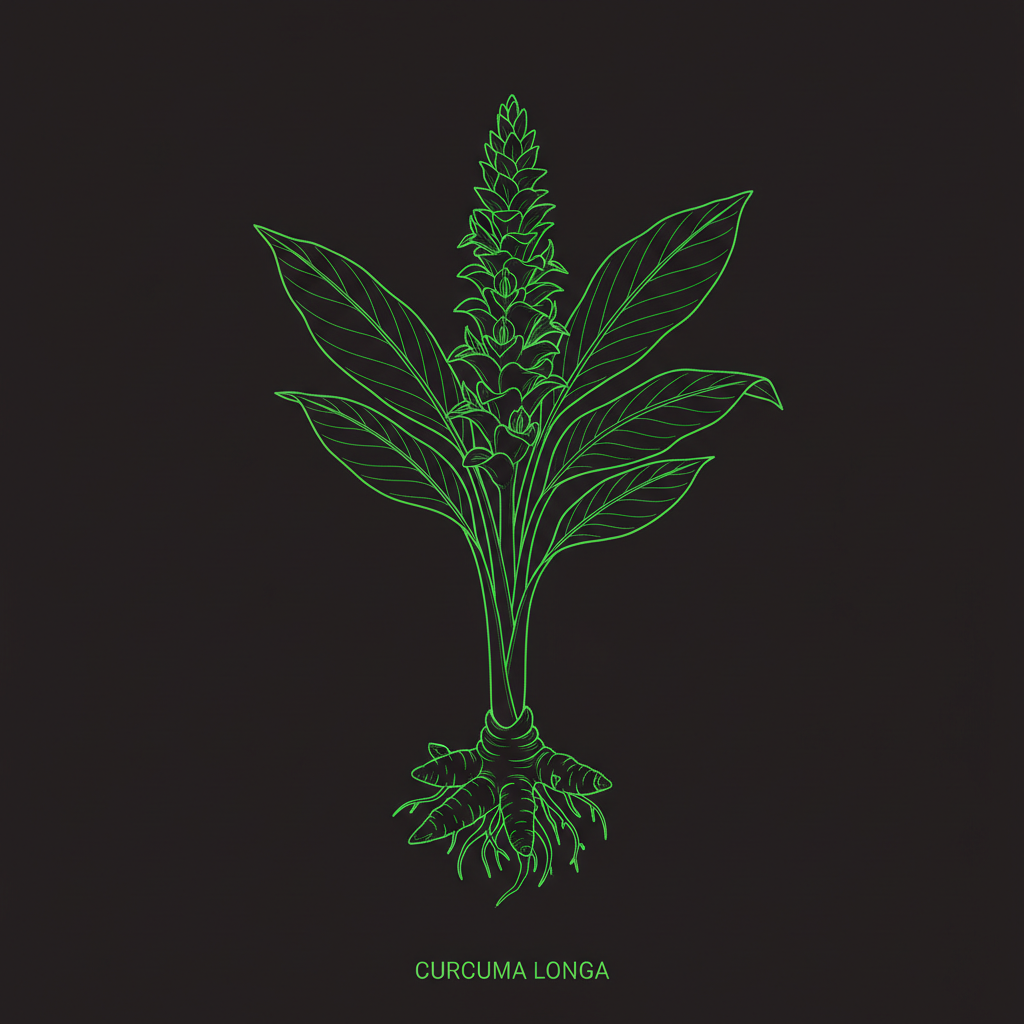
Botanical illustration — Curcuma longa
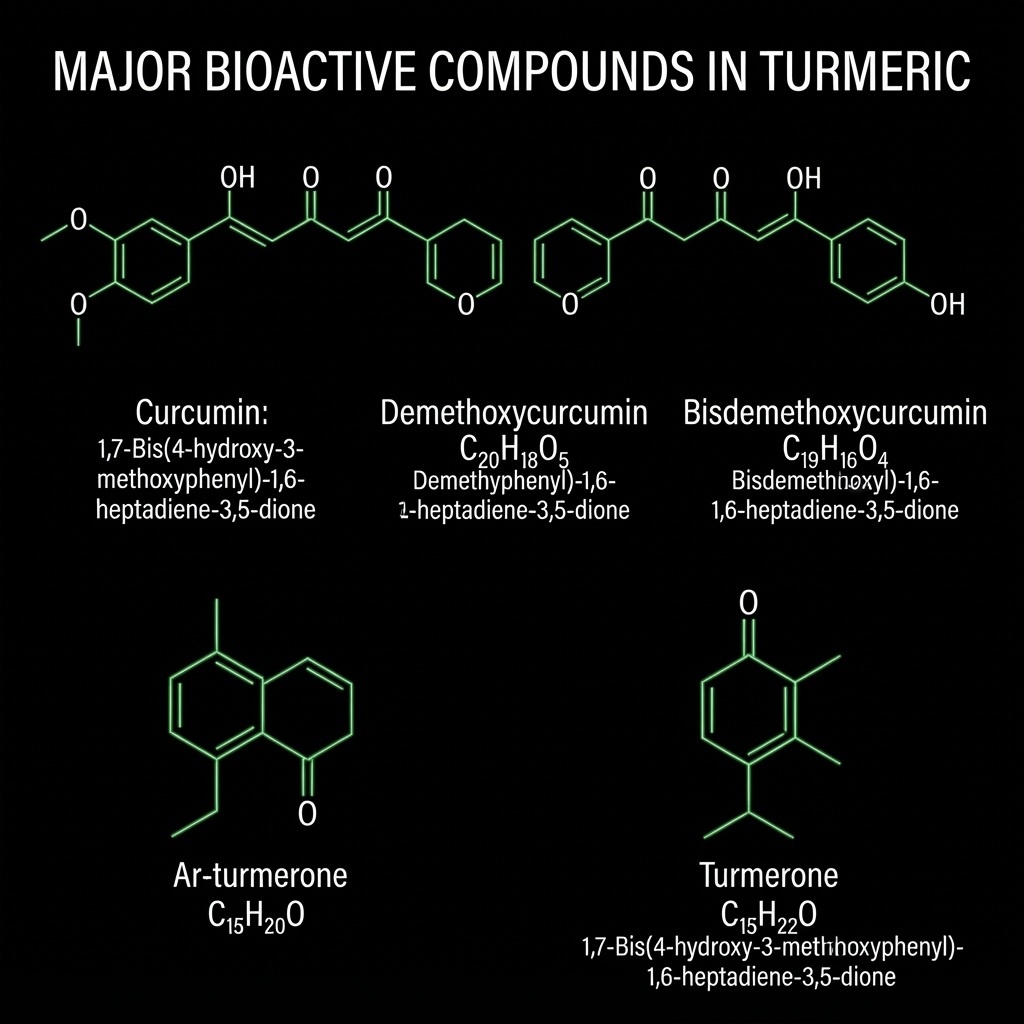
Molecular structures — key phytochemicals
Botanical Profile
A rhizomatous perennial plant of the ginger family, turmeric has been used in Ayurvedic and traditional Chinese medicine for over 4,000 years. Its primary bioactive compound, curcumin, is one of the most extensively studied phytomedicinals in modern pharmacology.
Morphology
Herbaceous perennial growing 60–90 cm tall. Large oblong leaves with narrow lanceolate blades. Rhizomes are bright orange-yellow internally, tuberous, and aromatic. Inflorescence is a cylindrical spike with pale yellow flowers enclosed in green bracts.
Traditional & Ethnobotanical Uses
Used extensively in Ayurvedic medicine as an anti-inflammatory, hepatoprotective, and wound-healing agent. In Traditional Chinese Medicine, used to invigorate blood, stimulate qi, and alleviate pain. Traditional applications include treatment of digestive disorders, skin conditions, respiratory ailments, and as a general tonic. Cultural use as a culinary spice and natural food preservative spanning millennia.
Phytochemical Profile
The primary bioactive constituents are curcuminoids (3–5% of rhizome by weight), predominantly curcumin (diferuloylmethane), demethoxycurcumin, and bisdemethoxycurcumin. Also present are sesquiterpene hydrocarbons including ar-turmerone, α-turmerone, and β-turmerone (essential oil 2–7%), as well as polysaccharides with immunomodulatory activity. Bioavailability of curcumin is notably low due to poor aqueous solubility, rapid metabolism, and systemic elimination; co-administration with piperine enhances bioavailability by up to 2000%.
Mechanisms of Action
Curcumin exerts pleiotropic effects through multiple molecular targets: (1) Downregulation of NF-κB pathway, reducing expression of pro-inflammatory cytokines TNF-α, IL-1β, IL-6; (2) Inhibition of COX-2 and 5-LOX, reducing prostaglandin and leukotriene synthesis; (3) Modulation of AMPK and mTOR signalling pathways; (4) Upregulation of Nrf2/ARE pathway, enhancing endogenous antioxidant defences including glutathione, catalase, and SOD; (5) Inhibition of JAK/STAT pathway; (6) Regulation of growth factor signalling including EGFR and VEGF; (7) Modulation of cell cycle regulators p53, p21, and cyclin D1.
Clinical Indications
Conditions
Symptoms
Dosage & Preparation
Standardised extracts providing 400–600 mg curcuminoids per day, typically in 2–3 divided doses. Bioavailability-enhanced formulations (e.g., with piperine, as liposomal, or as nano-particle preparations) allow lower doses of 250–500 mg. Rhizome powder: 1–3 g daily. Curcumin with piperine: 500 mg curcumin + 5 mg piperine twice daily.
Safety & Interactions
Contraindications
Contraindicated in biliary obstruction and gallstones (stimulates gallbladder contraction). Caution in pregnancy at therapeutic doses (emmenagogic and uterotonic effects reported). Discontinue 2 weeks prior to elective surgery due to antiplatelet effects. Caution in patients with iron deficiency (curcumin chelates iron).
Drug Interactions
Anticoagulants and antiplatelet agents (warfarin, aspirin, clopidogrel) — additive antithrombotic effect increases bleeding risk. CYP3A4 substrates — curcumin may inhibit CYP3A4, potentially altering drug metabolism. P-glycoprotein substrates — modulation may affect drug transport. Enhanced bioavailability with piperine may increase levels of concurrently administered medications metabolised by CYP3A4 or glucuronidation.
My Research Notes
No notes yet.
References
- [1]Gupta SC, et al.
- [2]Multitargeting by curcumin as revealed by molecular interaction studies.
- [3]Nat Prod Rep. 2011.
- [4]28(12):1937-55.
- [5]Aggarwal BB, Harikumar KB.
- [6]Potential therapeutic effects of curcumin.
- [7]Int J Biochem Cell Biol. 2009.
- [8]41(1):40-59.
- [9]Hatcher H, et al.
- [10]Curcumin: from ancient medicine to current clinical trials.
- [11]Cell Mol Life Sci. 2008.
- [12]65(11):1631-52.
- [13]Daily JW, et al.
- [14]Efficacy of turmeric extracts and curcumin for alleviating arthritis symptoms: a systematic review.
- [15]J Med Food. 2016.
- [16]19(8):717-29..
Latest Research
PubMed LiveCurcumin (Curcuma longa): Applications in Clinical, Regenerative, and Aesthetic Dermatology.
Effects of curcumin on depression, anxiety, and stress symptoms in adults: a GRADE-assessed systematic review and dose-response meta-analysis.
Curcumin in ovarian cancer: mechanistic insights and translational potential.
Plant-derived phytochemicals for Alzheimer's disease: mechanisms of action, experimental evidence, and therapeutic perspectives.
Targeting oral cancer with curcumin and its structural analogs: molecular mechanisms, pharmacokinetic optimization, and clinical translation.
EFFECTS OF CURCUMIN ON CLINICAL OUTCOMES AND INFLAMMATORY BIOMARKERS IN KNEE OSTEOARTHRITIS: A RANDOMIZED TRIAL.
Curcumin-mediated Modulation of T-bet and CD8+ T Cells: A Potential Anti-inflammatory Mechanism in Knee Osteoarthritis.
Curcumin Delivery Systems for Inflammatory Skin Application: A Review.